 English
 русский
 Español
 عربى
How Does a Dry Type Transformer Work? Core, Cooling and Selection Guide
Content
- 1 What Makes a Dry-Type Transformer Different
- 2 How a Dry-Type Transformer Works: The Induction Path Step by Step
- 3 How a Dry-Type Transformer Stays Cool Without Oil
- 4 Dry Type vs Oil Immersed: The Site Conditions That Decide
- 5 Where the Dry-Type Transformer Sits in a Distribution System
- 6 Specification Checks Before You Order a Dry-Type Transformer
- 7 FAQ
A 1,600 kVA dry-type transformer installed on the fourth floor of a hospital block has no oil conservator, no bunded pit and no fire-rated vault beneath it. That one installation detail explains most of the engineering inside the machine: the unit changes voltage exactly the way an oil-immersed transformer does, but every part of its insulation and cooling system is solid or gaseous instead of liquid.
How does a dry type transformer work in practice? Alternating current in the primary winding drives a changing magnetic flux around a laminated core, that flux cuts the secondary winding and induces a voltage across it, and the turns ratio between the two windings fixes the output voltage. Everything that separates a dry-type design from an oil-filled one happens after that point: heat has to travel through cast resin and moving air, so thermal design rather than electromagnetic design sets the continuous rating.
What Makes a Dry-Type Transformer Different
A dry-type transformer is a static electrical device that changes alternating voltage by electromagnetic induction while its windings and core are insulated with solid materials and cooled by air instead of insulating liquid.
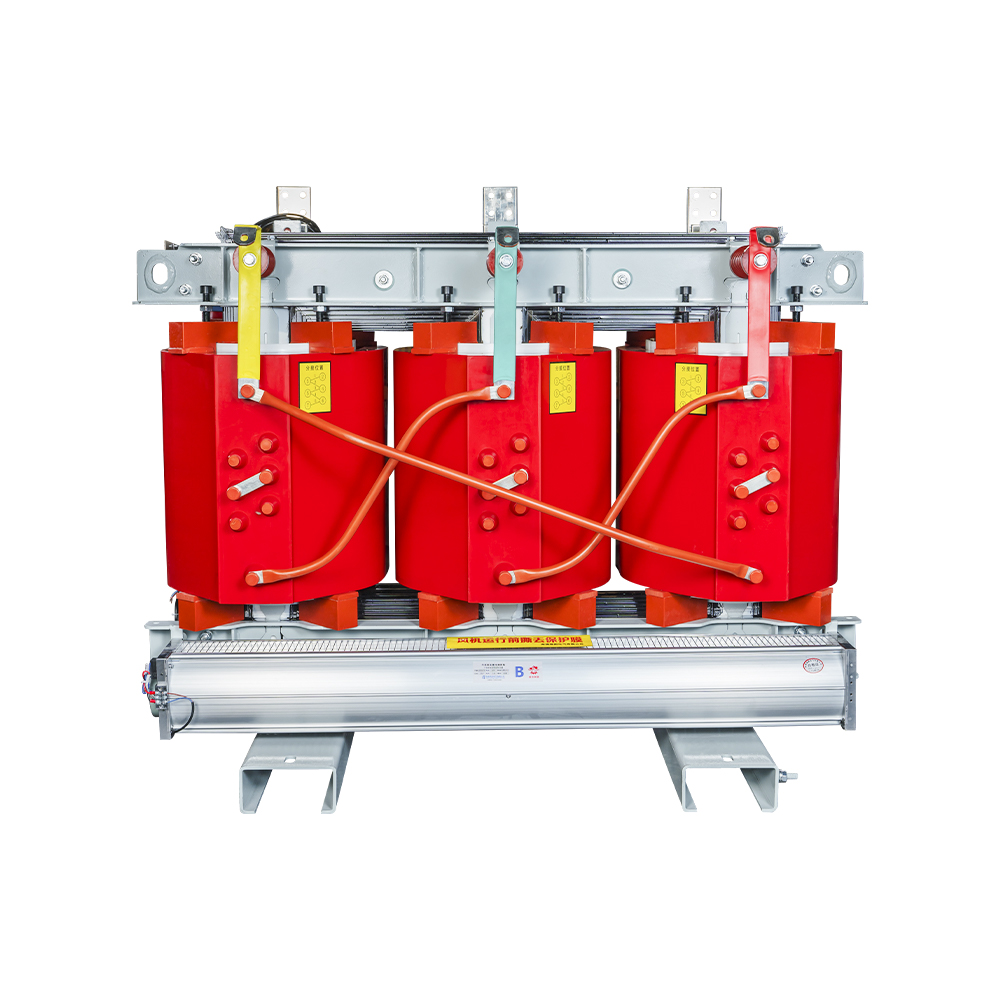
Definition: a dry-type transformer is a power or distribution transformer whose active part sits in air and whose winding insulation is a solid dielectric, most often filled epoxy resin, rather than mineral oil or synthetic ester.
Remove the oil and three things leave with it: the tank and conservator that hold the liquid, the bunded pit and fire-rated vault that building codes demand around it, and the oil sampling regime that keeps the liquid dry. What you get instead is a heavier, larger and more expensive machine per kVA that can be installed almost anywhere a room has ventilation.
The construction families that appear in real specifications are limited:
- Cast-resin dry type: windings vacuum-cast in filled epoxy, the default for 6-35 kV indoor distribution duty.
- Resin-encapsulated dry type: a thinner resin coating over impregnated windings, common in smaller ratings.
- Vacuum pressure impregnated (VPI) dry type: varnish impregnation under vacuum, typical at 1 kV class and below.
- Core variants: laminated silicon steel for conventional loss levels, or amorphous alloy when no-load loss has to be cut to a minimum.
How a Dry-Type Transformer Works: The Induction Path Step by Step
The working principle is identical to every other transformer built since the 1880s: a changing magnetic field links two windings that share a core, and the turns ratio between them sets the voltage ratio. Only the insulation wrapped around that field changes.
- Magnetising current builds the flux. With alternating current applied to the primary winding, a small magnetising current establishes an alternating flux in the core, reversing direction every half cycle at 50 Hz or 60 Hz.
- The core carries the flux. Laminated silicon steel restricts eddy currents to thin sheets; an amorphous alloy core performs the same job with lower no-load loss and a higher purchase price.
- The secondary winding sees a changing field. Faraday's law does the work here: any conductor linked by changing flux has a voltage induced in it, at the same frequency as the supply.
- The turns ratio sets the output. Primary voltage divided by secondary voltage equals primary turns divided by secondary turns, so a 10,000 V primary and a 400 V secondary need a 25 to 1 turns ratio. Impedance, not turns, decides how far the voltage sags under load.
- Load current balances the ampere-turns. Secondary current creates a counter-flux, primary current rises to balance it, and primary ampere-turns stay approximately equal to secondary ampere-turns.
- Losses become heat. No-load loss lives in the core laminations; load loss lives in winding resistance plus eddy and stray losses. Both end up inside a sealed resin block that must shed them to room air.
A 1,000 kVA dry-type distribution transformer typically returns 98 to 99 percent efficiency between half load and three-quarter load. The one or two percent that never reaches the secondary winding becomes heat that has to cross the resin and the surrounding air, which is why cooling and insulation class dominate the specification.
The same physics scales upward through larger units, and a walkthrough of three-phase power transformer engineering principles and selection criteria covers how impedance, loading and protection change at higher ratings.
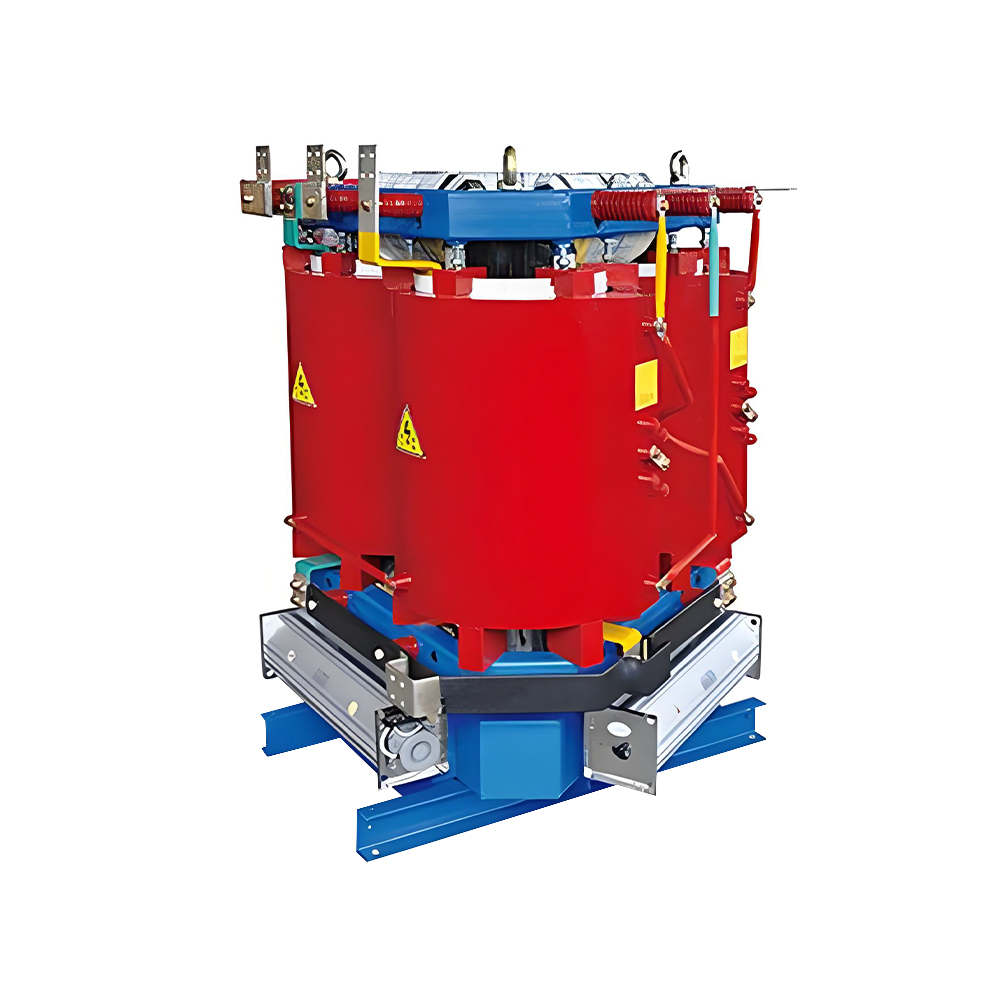
Where no-load loss is the deciding cost across a twenty-year service life, an amorphous alloy core dry-type transformer built to the same insulation class reduces that component without changing the electrical principle at all.
How a Dry-Type Transformer Stays Cool Without Oil
Heat leaves a dry-type transformer by conduction through solid insulation and then by convection and radiation into the surrounding air, so the continuous rating is fixed by an insulation class rather than by an oil temperature rise.
Two cooling codes cover almost every unit sold. AN means air natural, where convection alone carries heat away from the winding surfaces. AF means air forced, where fans push air through the cooling ducts and lift usable capacity by roughly 25 to 40 percent. The AF stage only counts if the fans are monitored, because a stalled fan turns a forced-cooled rating into an overload.
Monitoring follows directly from that rule. Winding-mounted Pt100 sensors feed a temperature controller with a typical Class F setting of an alarm near 130 and a trip near 150 degrees Celsius, while the fans start automatically on the forced-air stage. Enclosure protection matters as much as cooling: IP00 open units suit dedicated electrical rooms, louvered IP20 and IP21 enclosures suit general indoor installation, and IP23 or higher is required outdoors or in dusty and humid plants.
Dry Type vs Oil Immersed: The Site Conditions That Decide
Indoor, fire-sensitive and inspection-heavy locations choose dry type; outdoor, high-rating and cost-driven locations choose oil. That single sentence settles most transformer selection arguments before the electrical calculations even start.
| Criterion | Dry type | Oil immersed |
| Insulation and cooling medium | Cast resin or impregnated solid insulation, cooled by air | Mineral oil or ester liquid circulating by natural or forced flow |
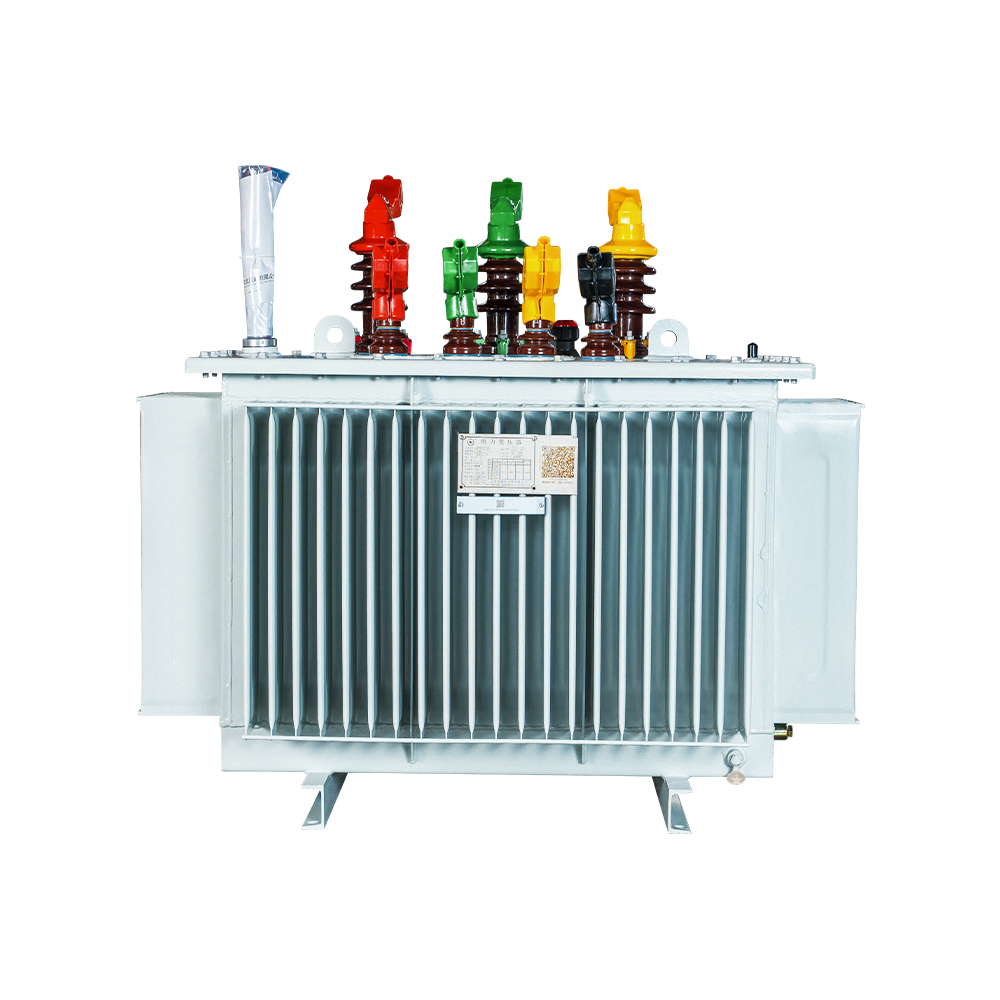
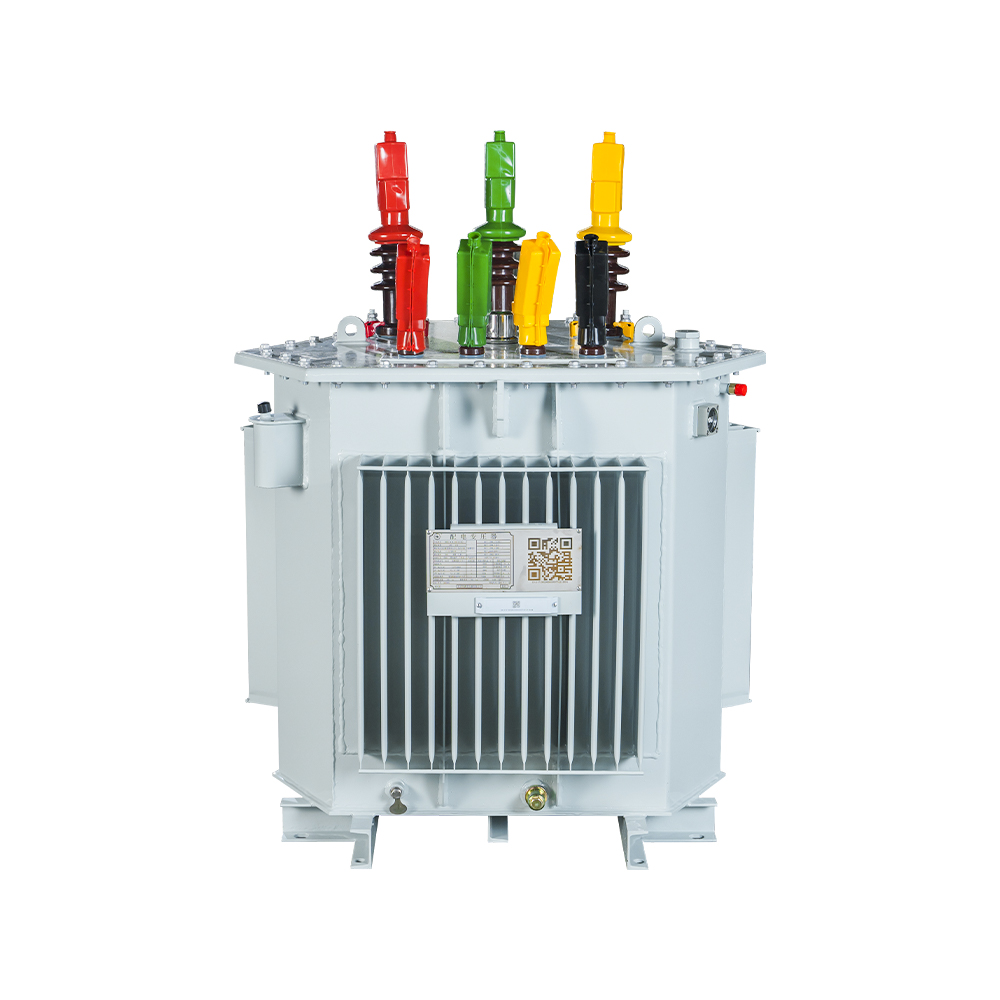
| Fire and building code load | No oil pool, no bunded pit, reduced fire load | Requires oil containment, fire separation and often a vault |
| Typical installation | Basements, upper floors, hospitals, data halls, tunnels | Outdoor yards, pole and pad mounting, generating stations |
| Practical size ceiling | Commonly 6-35 kV class, up to a few MVA per unit | Distribution class through transmission voltages |
| Maintenance routine | Cleaning, torque checks, fan and sensor tests, no oil sampling | Oil testing, gasket and breather care, occasional reclamation |
| Footprint and mass | Larger and heavier per kVA, noisier without low-noise design | Compact for the same rating, naturally damped by the tank |
| First cost | Higher per kVA at the same rating | Lower per kVA at the same rating |
Specify dry type when
- The unit sits indoors among people, equipment or escape routes.
- No bunded pit or fire-rated vault exists in the structure.
- Fire load and insurance review outweigh first cost.
- Maintenance access is limited to inspection and cleaning.
Specify oil immersed when
- The transformer stands outdoors with room for containment.
- Ratings exceed what a dry-type unit delivers economically.
- Liquid testing sits inside the operator's normal routine.
- First cost and footprint dominate the procurement decision.
For indoor distribution duty, a three-phase dry-type transformer with a silicon steel core remains the conventional workhorse because its loss profile and price balance better than an amorphous core at low loading, and its thermal behaviour is well understood by any commissioning engineer.
Where the Dry-Type Transformer Sits in a Distribution System
The dry-type transformer sits between the medium-voltage switching point and the low-voltage distribution board, and its rating decides how everything around it is built.
Ahead of it, a medium-voltage ring main unit such as the HXGN or XGN15-12 type takes the incoming feeder and provides the switching, earthing and protection needed to isolate the transformer safely. Behind it, low-voltage withdrawable switchgear from the GCK, GCS or MNS family handles the outgoing feeders, a metering box takes the supply measurement, cable branch boxes split the runs, and a reactive compensation device holds the power factor where the utility requires it. In a compact substation such as the YB series, all those parts arrive pre-assembled around the transformer in a single enclosure.
Protection coordination is the interface risk that decides whether a dry-type installation runs quietly or trips on every energisation. Transformer impedance, magnetising inrush and the protection curve of the upstream ring main unit have to line up, and the low-voltage breaker rating has to be checked against the transformer's short-circuit current rather than against its nominal current.
Jiangsu Hengyuan Transformer Co., Ltd. manufactures both ends of that chain, and the transformer, switchgear and substation range covers the matched components for indoor distribution rooms, industrial plants and infrastructure projects.
Specification Checks Before You Order a Dry-Type Transformer
Six checks change the nameplate rating of a dry-type transformer, and each of them should be settled before the purchase order is issued rather than after the unit arrives on site.
- Ambient and altitude. Units are rated at a 40 degree Celsius maximum ambient and 1000 m altitude; above that height the standard reduces allowable temperature rise, which usually costs roughly 0.5 to 1 percent of capacity per additional 100 m.
- Harmonic loading. Non-linear loads add eddy-current loss in the windings and push hot spots upward, so a K-factor rating or an explicit derating factor is required for data halls and drive-heavy plants.
- Enclosure and IP rating. IP00 for dedicated electrical rooms, IP21 or IP23 for general indoor and outdoor installation, higher ratings for dusty and humid environments.
- Sound level. Dry-type units typically run between 50 and 65 dB(A) at one metre, so low-noise construction is specified when the room is occupied or adjacent to working areas.
- Impedance and short-circuit coordination. Distribution dry types commonly sit at 4 to 6 percent impedance, and that figure must be checked against low-voltage breaker ratings and upstream protection settings.
- Temperature monitoring and fans. Three Pt100 sensors plus a controller with alarm, trip and fan-start outputs; a forced-air rating is only valid when fan failure raises an alarm.
Ventilation is part of the electrical design, not a building afterthought. A dry-type transformer rejects its losses into the room, so the room needs enough air exchange to keep ambient near the design value, and the clearance in front of the windings has to allow convection as well as maintenance access.
FAQ
Does a dry-type transformer work because of an air gap between the windings?
No. The name describes the cooling and insulation medium, not the magnetic circuit. A dry-type unit still uses a closed laminated core with no deliberate air gap in the flux path; the only air involved is the cooling air around the outside of the resin-encapsulated windings. An actual air gap in the core would raise magnetising current dramatically.
Can a dry-type transformer be installed outdoors?
Yes, provided the enclosure is rated for the environment. IP23 enclosures with rain hoods are used outdoors, and IP54 or higher enclosures are specified in dusty, humid or coastal locations. Outdoor installation still requires shade and airflow planning, because direct solar gain reduces the usable capacity of an air-cooled unit.
How much maintenance does a dry-type transformer need?
Less than an oil-filled unit but not none. A practical routine covers an annual visual inspection, cleaning of dust from winding surfaces and cooling ducts, retorquing of busbar and cable terminations, functional testing of fans and the temperature controller, and periodic insulation resistance measurement. Dust and loose terminations cause most dry-type failures, not resin ageing.
Is a dry-type transformer suitable for harmonic-rich loads?
Yes, with the right specification. Harmonic currents increase eddy losses in the windings and create local hot spots that a standard rating does not account for, so a K-rated design or a derating factor of 10 to 25 percent is applied for data centres, rectifier loads and variable-frequency drive installations.
The underlying answer to how a dry type transformer works never changes: flux links two windings, turns ratio sets the voltage, and load current balances ampere-turns. What changes is the thermal pathway, and that pathway is what you actually buy. Settle the ambient, altitude, harmonic and enclosure conditions first, then the kVA rating, the cooling code and the insulation class follow naturally from the numbers rather than from habit.
Recommended Products

 Contact

Contact
-

wxj.810@163.com
-

+86-523-82962116
-

No. 111, Guoqing East Road, Chengdong High-tech Industrial Park, Taixing City, Jiangsu Province, China
Copyright © 2026 by Jiangsu Hengyuan Transformer Co., Ltd. Rights Reserved.
